Bi-folding or sliding? It's the question we get asked most often. Both are excellent choices — but they suit different homes, openings and lifestyles. Here's our honest comparison.
Bi-Folding Doors vs Sliding Doors: The Honest Comparison
It's the question we get asked more than any other at Behind The Glass: should I go for bi-folding doors or sliding doors?
Both are premium aluminium door systems. Both will transform your home. Both will connect your living space to your garden in a way that no other door type can match. But they are genuinely different products that suit different situations — and choosing the wrong one is a mistake you'll notice every day.
Here's our honest, practical comparison, based on years of installing both systems across Manchester, Lancashire, Rossendale, Burnley, Rochdale and Bury.
How Each System Works
Bi-Folding Doors
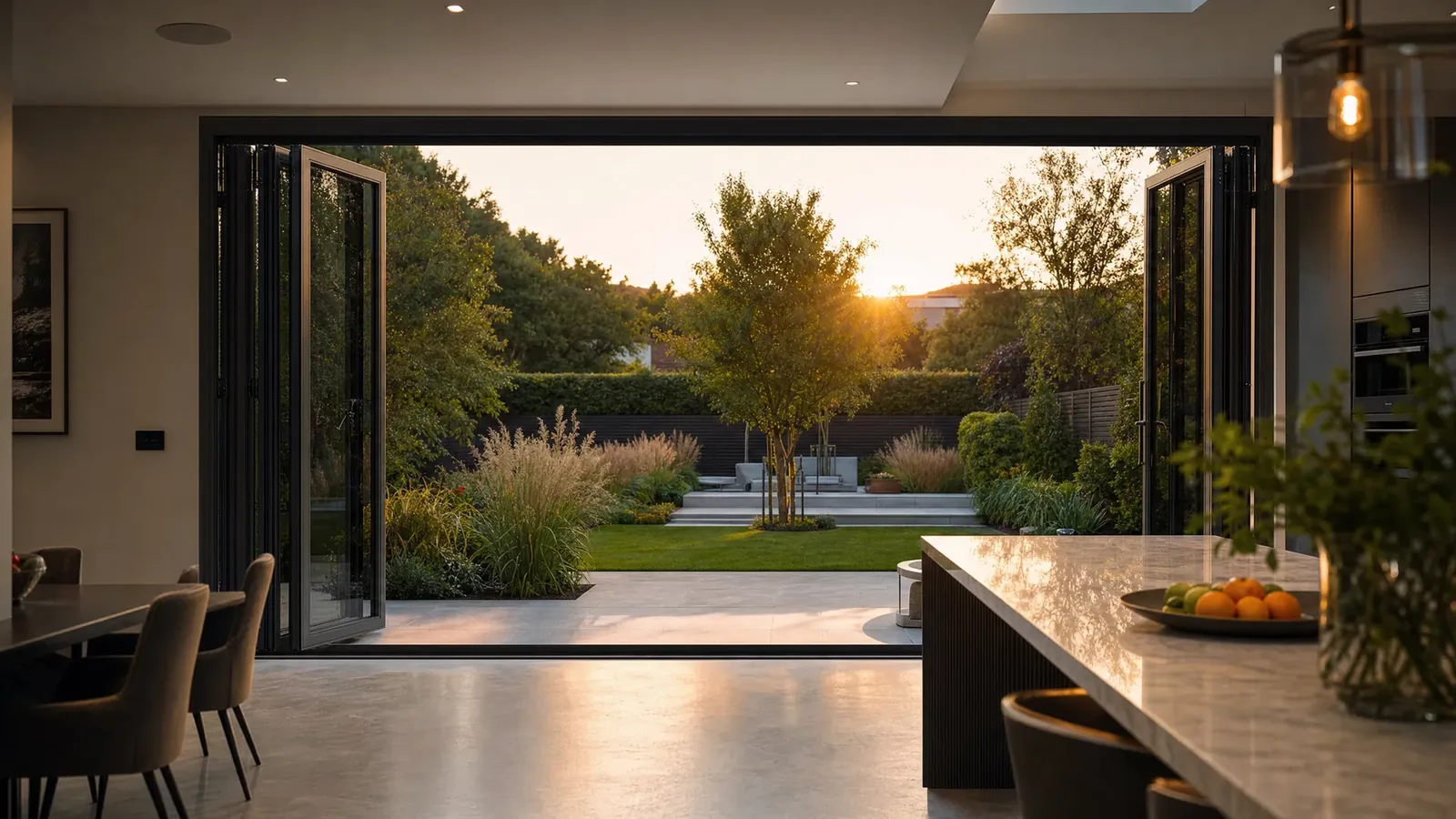
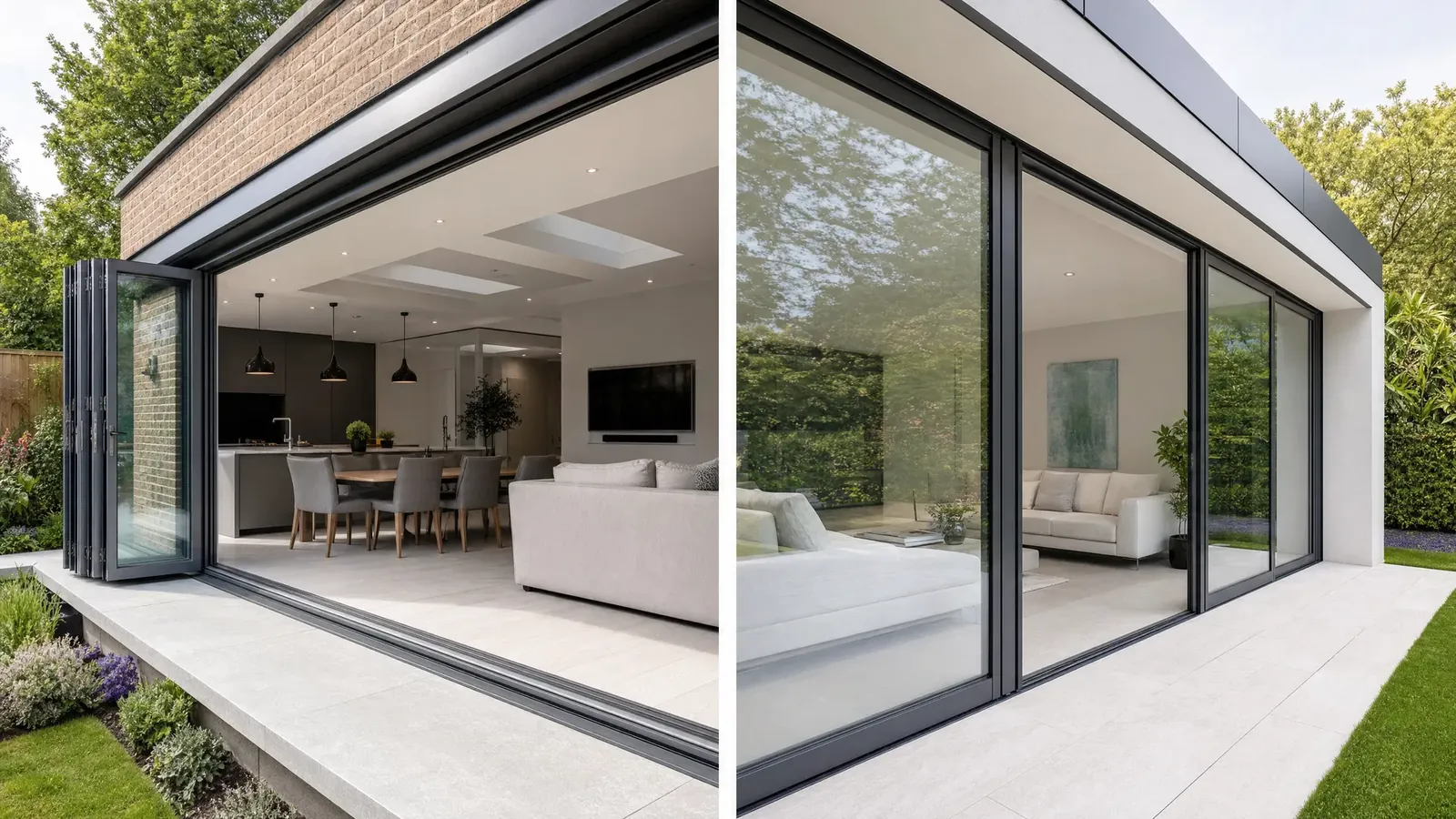
Bi-folding doors consist of multiple panels that fold concertina-style and stack neatly to one or both sides of the opening. When fully open, they create an almost unobstructed aperture — the entire width of the opening becomes open space.
A typical 3-panel bi-fold might stack to one side, while a 4 or 6-panel set can split and stack to both sides, leaving just the corner posts. The result is a seamless transition between inside and outside.
Sliding Doors
Sliding doors — also called ultra-slim sliding doors or lift-and-slide doors — operate on a track system. Panels glide horizontally past each other. In a 2-panel configuration, one panel slides behind the other, leaving half the opening clear. In a 3-panel system, two panels can slide to one side.
The key difference: sliding doors never fully open the entire width. There will always be at least one fixed or stacked panel occupying part of the frame.
The Key Differences
| Feature | Bi-Folding Doors | Sliding Doors |
|---|---|---|
| Maximum opening | Full width (near 100%) | Typically 50–66% of width |
| Frame sightlines | Slightly wider (multiple panels) | Ultra-slim (fewer panels) |
| Operation | Fold and stack | Glide on track |
| Minimum opening | Any panel can open independently | Full panel must move |
| Best for | Maximising the opening | Maximising the view |
| Typical cost | £3,500–£8,000 | £4,000–£9,000 |
| Maintenance | Low | Very low |
When to Choose Bi-Folding Doors
Bi-folding doors are the better choice when:
You want the opening to be as wide as possible. If you're hosting garden parties, have young children running in and out, or simply want the garden to feel like an extension of your living space on warm days, bi-folds deliver an opening that sliding doors simply cannot match.
Your opening is between 2.4m and 6m wide. Bi-folds work exceptionally well in this range. Below 2.4m, a single or double door may be more practical. Above 6m, large-format sliding doors often make more sense structurally.
You want flexibility. Most bi-fold configurations include a 'traffic door' — a single panel that can be opened independently for everyday use, without folding back the entire set.
Budget is a consideration. Bi-folding doors are typically slightly less expensive than equivalent sliding door systems.
When to Choose Sliding Doors
Sliding doors are the better choice when:
You want the slimmest possible frames. Sliding door systems — particularly lift-and-slide systems — can achieve sightlines of just 20–25mm. With fewer panels and no folding mechanism, the frames are genuinely minimal. The result is a wall of glass that prioritises the view.
Your opening is very wide. For openings above 5–6m, large-format sliding panels are structurally more straightforward than a multi-panel bi-fold. A 4-panel sliding door across a 6m opening can look spectacular.
You want effortless operation. Premium lift-and-slide systems operate with a single handle turn and finger-tip movement, even on very large, heavy panels. There's no concertina folding — just a smooth, silent glide.
You have limited space for stacking. Bi-folding doors need clear space to one or both sides to stack the panels. If your layout doesn't allow for this — a corner position, for example — sliding doors are the practical solution.
What About the View?
This is where sliding doors have a genuine advantage. Because they have fewer panels and slimmer frames, a closed sliding door offers a cleaner, less interrupted view of the garden. If you're looking at a beautiful Lancashire countryside view or a well-designed garden, sliding doors frame it better.
Bi-folding doors, when closed, have more vertical frame lines across the opening — which some people find visually busy. When open, of course, this is irrelevant.
Our Recommendation
If you want maximum opening and are primarily thinking about how the doors feel when open — choose bi-folding doors.
If you want maximum view and are primarily thinking about how the doors look when closed — choose sliding doors.
Both are excellent investments. Both will transform your home. The right choice depends on how you live and what you value most.
Not sure which is right for your home? Book a free survey and one of our specialists will visit, assess your opening and give you an honest recommendation based on your specific situation.
Frequently Asked Questions
Which is more expensive — bi-folding or sliding doors?
Sliding doors are typically slightly more expensive, particularly lift-and-slide systems. The difference is usually £500–£1,500 for equivalent quality.
Can I get bi-folding doors in anthracite grey?
Yes — anthracite grey (RAL 7016) is our most popular colour for both bi-folding and sliding doors. We offer over 200 RAL colours.
Do bi-folding doors let in draughts?
Quality bi-folding doors with good seals and thermally broken profiles are very draught-resistant. Cheaper systems can be draughty — which is why specification matters.
How wide can sliding doors be?
We regularly install sliding door systems up to 8m wide. Beyond this, structural engineering input is usually required.
Do you install bi-folding doors in Manchester?
Yes — Behind The Glass installs bi-folding and sliding doors across Greater Manchester, Lancashire, Cheshire and surrounding areas. Contact us for a free survey.
Written by Craig Whitworth, Founder & Lead Installer, Behind The Glass.
Assure Certified Installer
Craig Whitworth is Founder & Lead Installer at Behind The Glass, a premium windows, doors and glazing specialist based in Rossendale, Lancashire.
Last updated: 19 October 2026